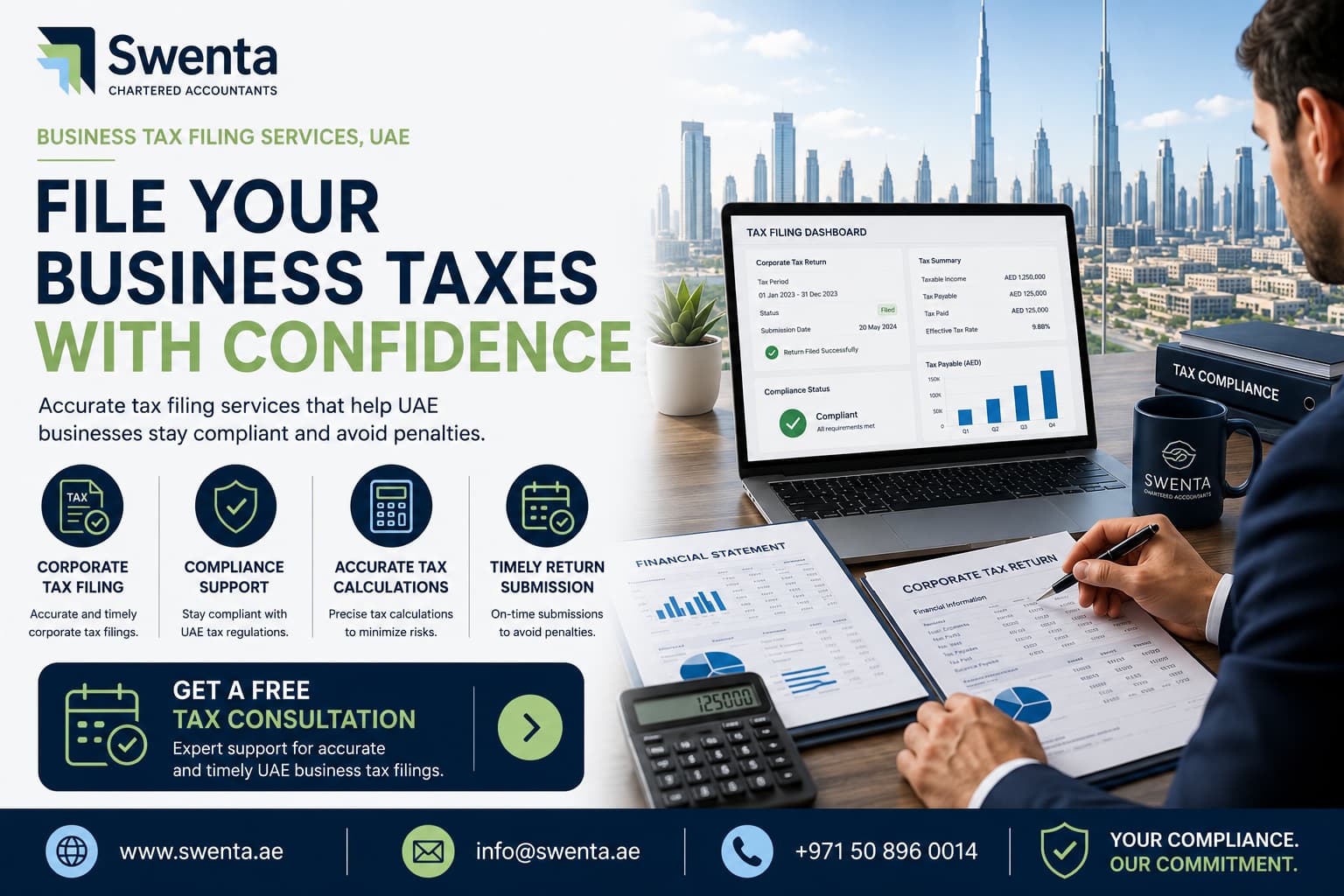
Business Tax Filing Services, UAE
Stay compliant and avoid costly penalties with Swenta’s Business Tax Filing Services. Our experts help UAE businesses manage tax obligations accurately, ensuring timely submissions and complete peace of mind.
Our Approach
Tax compliance requires accuracy, attention to detail, and a clear understanding of UAE regulations. Our team reviews your financial records, identifies filing requirements, and prepares submissions with precision. We focus on minimizing risks while helping your business remain fully compliant.
What We Offer
Corporate Tax Return Preparation
Corporate Tax Filing Services
Tax Compliance Reviews
Tax Record Assessment
Financial Data Verification
Tax Calculation Support
Regulatory Filing Assistance
Tax Documentation Management
Tax Advisory Support
Ongoing Compliance Monitoring
Why Businesses Across the UAE Choose Swenta for Business Tax Filing Services
Businesses trust Swenta because we provide reliable tax expertise backed by practical industry knowledge. Our professionals ensure filings are completed correctly and submitted on time. We simplify complex tax requirements, allowing business owners to focus on growth while staying compliant with UAE regulations.
What You Will Gain
Accurate tax filings
Reduced compliance risks
Timely submission of returns
Better tax record management
Improved financial transparency
Professional tax guidance
Greater confidence in compliance
Partner with Swenta for dependable Business Tax Filing Services that help your company meet tax obligations efficiently and confidently.
VAT Services
We offer comprehensive VAT services to ensure your business operates smoothly within the UAE VAT laws and minimises its tax exposure. Our services cover VAT registration, filing tax returns, checking transactions, providing VAT health checks, offering consultation, deregistering from VAT, and representing you in VAT audits. We serve various businesses to correctly implement VAT and comply with the FTA.
Key Benefits:
- Ensures the accurate filing of your VAT returns within the due dates.
- Eliminates regulatory fines and risks of other sanctions.
- Offers expert consultation for international or multi-jurisdiction transactions.
- Updates you regularly on any changes in the VAT legislation.
- Streamlines and strengthens your internal VAT processes and documents.
Our Approach:
We first learn about your business, transactions, and operational model. Secondly, we examine your VAT-related liabilities, risks, and areas for enhancement. Finally, based on this information, we set up proper VAT procedures, accurate tax returns, verified documentation, provide guidance throughout the way to maintain the compliance of the VAT law.
Client Value
You’ll benefit from greater accuracy in VAT compliance and fewer potential penalties, optimised VAT recovery, and better financial control. With us handling your VAT support, your business can continue to grow with peace of mind, knowing your tax obligations are taken care of.
FAQs
What are the requirements for VAT registration in the UAE?
Businesses in the UAE are required to register for VAT if their taxable supplies and imports exceed AED 375,000 within a 12-month period or are expected to exceed this threshold in the near future. Voluntary VAT registration is available for businesses whose taxable turnover or expenses exceed AED 187,500 but remain below the mandatory registration threshold. VAT registration enables businesses to comply with UAE tax regulations and charge VAT on eligible goods and services. Timely registration helps avoid potential penalties, compliance issues, and administrative complications with the tax authorities. It also allows businesses to maintain proper tax records and meet their ongoing VAT reporting obligations.
How often should VAT returns be submitted?
VAT returns in the UAE are generally submitted on a quarterly basis; however, the filing frequency is determined by the tax authority and may vary depending on the nature and size of the business. In certain cases, businesses with higher transaction volumes or specific compliance requirements may be required to file VAT returns monthly. It is important to review the filing period assigned by the relevant authority and ensure that returns are submitted within the specified deadlines. Timely filing helps businesses remain compliant with VAT regulations and avoid penalties or administrative issues. Maintaining accurate records throughout the reporting period also supports efficient and accurate VAT return preparation.
Is it possible to claim input tax on expenses incurred by the business?
Yes, businesses may be able to recover input VAT on eligible expenses incurred for business purposes, subject to the applicable VAT regulations and requirements. To claim input tax, businesses must maintain valid tax invoices and supporting documentation that clearly demonstrate the business nature of the expense. Recoverable input tax can help reduce the overall VAT liability and improve cash flow management. However, certain expenses may be restricted or excluded from VAT recovery under the applicable rules. It is important to review each expense carefully to determine its eligibility and ensure compliance with VAT regulations before submitting a claim.
What are the consequences if VAT returns are filed after their deadline?
Filing VAT returns after the prescribed deadline may result in penalties and administrative fines imposed by the relevant tax authority. Late submission can also lead to additional charges if any VAT payable remains outstanding beyond the due date. Repeated non-compliance with VAT filing and payment obligations may increase the risk of further regulatory scrutiny, including tax audits and compliance reviews. Timely filing is essential to maintain good standing with the tax authorities and avoid unnecessary financial penalties. Maintaining accurate records and meeting all filing deadlines helps ensure ongoing compliance with VAT regulations and reduces the risk of enforcement actions.
What are the VAT rules applicable to international trade?
VAT treatment for international trade depends on the nature of the goods or services being supplied and the countries involved in the transaction. Certain international transactions may qualify for zero-rating, while others may be exempt or subject to standard VAT rules based on the applicable regulations. The correct VAT treatment requires careful assessment of supporting documents, transaction details, and compliance requirements. Understanding these rules is important to ensure accurate VAT reporting and avoid potential compliance issues. We can provide guidance on the VAT implications of international transactions and help ensure that your business applies the appropriate VAT treatment in accordance with the relevant regulations.
Corporate Tax Services
We are equipped to offer comprehensive Corporate Tax services designed to help businesses correctly interpret the newly introduced UAE Corporate Tax law and benefit from efficient tax planning strategies. We provide assistance with Corporate Tax registration, compute the taxable income, calculate the tax payable, and file the return on your behalf. We also offer advice on structuring and compliance issues and serve clients operating across the UAE.
Key Benefits:
- Precise calculations and reporting of the Corporate Tax liability.
- Strategic tax planning and optimisation advice.
- Minimise risk associated with penalties and regulatory contraventions.
- Tailored tax advice on your individual business activities and operations.
- Continuous support regarding the UAE tax regime changes.
Our Approach:
We start by reviewing your business’s financial statements, activities, and legal structure. Our next step involves conducting a tax exposure assessment and evaluating the compliance requirements. Finally, we establish viable tax strategies and correctly fill in and file the Corporate Tax returns, and also continue to offer support to guarantee ongoing compliance.
Client Value
With our support, you benefit from improved financial decisions and minimised regulatory risk, enhanced tax efficiency, and full compliance with the laws. Our services enhance your business growth through strategic tax management.
FAQs
Who must register for UAE Corporate Tax?
Most businesses and legal entities operating in the UAE are required to register for Corporate Tax in accordance with the applicable tax regulations. This includes mainland companies, certain free zone entities, and other businesses that fall within the scope of the Corporate Tax regime. While some entities may qualify for exemptions or special tax treatments, registration requirements can vary depending on the nature of the business and its activities. It is important to assess each business individually to determine its registration obligations. Proper registration helps ensure compliance with tax regulations and avoids potential penalties or administrative issues. We can assist in evaluating your business and guiding you through the Corporate Tax registration process.
What is the rate of UAE Corporate Tax?
The UAE Corporate Tax regime generally applies a tax rate of 9% on taxable income that exceeds the prescribed threshold set by the applicable regulations. Taxable income below the specified threshold may be subject to a 0% rate, providing relief for smaller businesses and startups. In addition, certain qualifying free zone entities may continue to benefit from a 0% Corporate Tax rate on eligible income, provided they meet the relevant conditions and compliance requirements. The applicable tax treatment depends on the nature of the business and its activities. Understanding the correct tax rate and eligibility criteria is essential for accurate tax planning, reporting, and compliance with UAE Corporate Tax regulations.
How often must Corporate Tax returns be filed?
Corporate Tax returns in the UAE are generally required to be filed annually for each tax period. Businesses must submit their Corporate Tax return along with any required supporting information and settle any tax liabilities within the prescribed deadline. In most cases, the return must be filed within nine months from the end of the relevant financial year. Timely filing is important to maintain compliance with UAE Corporate Tax regulations and avoid penalties or administrative issues. Proper record-keeping throughout the year can help ensure that the filing process is accurate, efficient, and completed within the required timeframe.
Do free zone businesses get any exemption under the Corporate Tax regime?
Yes, certain free zone businesses may be eligible to benefit from a 0% Corporate Tax rate on qualifying income, provided they meet the conditions and requirements set out under the UAE Corporate Tax legislation and related regulations. Eligibility depends on factors such as the nature of the business activities, compliance with regulatory requirements, and adherence to the applicable rules governing qualifying free zone entities. Businesses must maintain proper records and continue to satisfy the prescribed conditions to retain these benefits. It is important to assess each free zone entity individually to determine its eligibility and ensure ongoing compliance with the Corporate Tax framework. Professional guidance can help businesses understand and apply the relevant provisions correctly.
What are the penalties applicable for failure to comply with Corporate Tax laws?
Failure to comply with UAE Corporate Tax regulations may result in penalties and administrative fines imposed by the relevant tax authority. Non-compliance can include late registration, failure to submit tax returns on time, inaccurate tax filings, non-payment of tax liabilities, or inadequate maintenance of supporting records and documentation. The severity of penalties may vary depending on the nature and extent of the violation. Maintaining accurate records and meeting all filing and reporting obligations is essential to remain compliant with the Corporate Tax framework. Timely compliance helps businesses avoid unnecessary penalties and ensures smooth interaction with the tax authorities.
Transfer Pricing Services
We help businesses navigate UAE Transfer Pricing compliance by providing services including benchmarking studies, policy development, documentation preparation and arm’s length assessments. We are specialists in supporting multinational groups and companies with related party transactions, ensuring full compliance with OECD-aligned legislation.
Key Benefits
- Full compliance with the UAE and OECD Transfer Pricing regulations
- Minimal risk of tax audits and adjustment of assessments
- Full preparation of Transfer Pricing documentation
- Expert economic and benchmark analysis on your transactions
- Transparency on all related party transactions
Our Approach
We analyse related party transactions based on functional and financial analysis, and conduct detailed benchmarking studies to identify the market prices for those transactions and detailed TP documentation, like Master files and Local files, including explanations of the approach. We also advise you on establishing clear and effective TP policies for your business, on an arm’s length basis.
Client Value
Our Transfer Pricing services reduce the risk of tax audit, develop and improve the tax compliance of your business, and bring transparency to your group’s related party transactions.
FAQs
What is Transfer Pricing?
Transfer Pricing refers to the pricing of transactions between related parties or entities that are part of the same group and operate in different jurisdictions. These transactions may involve the sale of goods, provision of services, loans, royalties, or other business arrangements. Under the UAE Corporate Tax regime, related-party transactions must be conducted in accordance with the Arm’s Length Principle, meaning that the terms and pricing should be similar to those that would apply between independent parties in comparable circumstances. This helps ensure that profits are allocated fairly and are not artificially shifted between entities. Proper transfer pricing practices support tax compliance, transparency, and accurate financial reporting while reducing the risk of disputes with tax authorities.
Who has to abide by the Transfer Pricing regulations in the UAE?
Transfer Pricing regulations in the UAE generally apply to businesses that engage in transactions with related parties or connected persons. Entities that have qualifying related-party transactions may be required to comply with transfer pricing rules and maintain appropriate supporting documentation in accordance with UAE Corporate Tax regulations. Additional documentation requirements may apply when the value of related-party transactions exceeds the prescribed thresholds or when transactions involve entities located in jurisdictions with lower tax rates. Compliance with transfer pricing regulations helps demonstrate that transactions are conducted at arm’s length and in accordance with applicable tax laws. Proper documentation and reporting are important to support transparency, reduce compliance risks, and meet regulatory requirements.
What documentation is needed for Transfer Pricing?
The Transfer Pricing documentation requirements depend on the size of the business, the nature of its operations, and the value of its related-party transactions. Depending on the applicable regulations, businesses may be required to maintain documentation such as a Master File, Local File, and Country-by-Country (CBC) Report. The Master File provides an overview of the group’s global business operations, organizational structure, and transfer pricing policies. The Local File focuses on the specific transactions and activities of the local entity, while the CBC Report presents information on revenue, profits, and taxes across different jurisdictions. Maintaining proper documentation helps demonstrate compliance with the Arm’s Length Principle and supports transparency during tax reviews or audits.
What is the ‘arm’s length principle’?
The Arm’s Length Principle is a fundamental concept in Transfer Pricing that requires transactions between related parties to be conducted on terms that are comparable to those agreed upon between independent and unrelated parties under similar circumstances. This means that the pricing, conditions, and commercial arrangements of related-party transactions should reflect normal market practices. The purpose of this principle is to ensure that profits are allocated fairly and are not artificially shifted between entities to obtain tax advantages. Compliance with the Arm’s Length Principle helps promote transparency, fairness, and consistency in financial and tax reporting. It also plays an important role in meeting Transfer Pricing requirements and reducing the risk of disputes with tax authorities.
When is it recommended to revise your TP policy?
It is generally recommended to review and update your Transfer Pricing (TP) policy on an annual basis to ensure that it remains aligned with current business operations and regulatory requirements. A review may also be necessary whenever there are significant changes in the business structure, financial performance, related-party transactions, or operational activities. Changes in tax regulations, market conditions, or group strategies may also impact the appropriateness of existing transfer pricing arrangements. Regular assessment helps ensure continued compliance with the Arm’s Length Principle and supports accurate tax reporting. Maintaining an up-to-date TP policy can also reduce compliance risks and provide stronger support during tax reviews or audits.
Tax Compliance & Filings
We provide comprehensive support to businesses for their tax filings. We work in the key area of making tax filings accurate, timely, and in accordance with all tax laws applicable to the business, for activities like VAT return filing, Corporate Tax filing, tax compliance checks, voluntary disclosures, documentation and authority correspondence.
Key Benefits
- Timeliness and accuracy of the filing process
- Ease of Tax Filing: The burden on your business
- Efficient handling of authority communications
- Minimised risk of errors or missed filings
- Reliable support with future compliance needs
Our Approach
We develop and implement a proper and organised tax filing schedule, collect all relevant business documents and information, and based on that, we proceed with the drafting and filing of Tax Returns within the stipulated time frame. We continually monitor the deadlines to enable businesses to avoid any last-minute complexities.
Client Value
Our Tax Filing service helps clients streamline and improve the tax compliance function, reduce the administrative effort involved, and achieve greater operational efficiency while having the confidence that their tax obligations are in expert hands.
FAQs
What types of tax returns are needed in the UAE?
The types of tax returns required in the UAE depend on the nature of the business, its legal structure, and the applicable regulatory requirements. Common tax filings include VAT returns, Corporate Tax returns, and other statutory submissions that may be required by the relevant authorities. Each return has specific reporting obligations, filing deadlines, and documentation requirements that must be met to maintain compliance. Accurate and timely filing helps businesses fulfill their legal responsibilities and avoid penalties or administrative issues. Proper tax compliance also supports transparency, regulatory adherence, and the smooth operation of business activities within the UAE.
Can a tax return be amended?
Yes, tax returns can generally be amended or corrected if errors, omissions, or inaccuracies are identified after submission. The amendment process is carried out in accordance with the applicable tax regulations and may involve revised filings, amended returns, or voluntary disclosure procedures, depending on the nature of the correction required. Promptly addressing any mistakes helps ensure that tax records remain accurate and compliant with regulatory requirements. Proper amendments can also help prevent future compliance issues and maintain the integrity of financial and tax reporting. It is important to review all supporting documentation carefully before submitting any corrections to the relevant authority.
What is needed when making a tax filing?
Preparing and submitting a tax return requires accurate financial records and supporting documentation. Commonly required documents include financial statements, invoices, bank statements, expense records, payroll information, and other relevant business documents that support the figures reported in the tax return. Maintaining complete and well-organized records helps ensure that tax filings are accurate, compliant, and supported by sufficient evidence. Proper documentation also makes it easier to respond to any queries or reviews from the relevant authorities. Good record-keeping practices are essential for efficient tax compliance and the timely preparation of tax returns.
Are there penalties for late filing of tax returns?
Yes, late filing of tax returns may result in administrative penalties, fines, and other regulatory consequences imposed by the relevant tax authority. Failure to meet filing deadlines can also lead to additional compliance obligations and increased scrutiny from the authorities. Repeated delays or non-compliance may expose a business to higher operational and financial risks, including audits or compliance reviews. Timely submission of tax returns is important to maintain good standing with regulatory authorities and avoid unnecessary penalties. Maintaining accurate records and monitoring filing deadlines can help ensure that all tax obligations are met efficiently and on time.
Do you communicate with tax authorities on our behalf?
Yes, we can assist with managing communications with the relevant tax authorities on behalf of your business regarding tax filings and compliance matters. This may include responding to requests for additional information, addressing queries related to submitted returns, and providing support during reviews, inspections, or audits. Acting as a point of contact helps ensure that communications are handled efficiently and in a professional manner. We also assist in coordinating the required documentation and information to support compliance requirements. This helps businesses manage tax-related matters more effectively while maintaining compliance with applicable regulations.
Tax Advisory & Planning
Our strategic Tax Advisory and Planning service offers bespoke solutions to make better business decisions with minimal tax liability. Our services span across business re-organisation, transactions and plans structuring, business expansion strategy, international tax matters, and optimum business setups.
Key Benefits
- Strategic tax planning in line with your business goals
- Discover proactive and cost-efficient tax saving opportunities.
- Mitigate your tax and regulatory risks.
- Receive tailored expert advice for strategic transactions and re-organisation
- Enhance your financial planning and decision-making processes.
Our Approach
We conduct thorough analysis on your business’s current position, goals, and financial health to identify business risks and opportunities, and then offer comprehensive, commercially viable, and practical advice aiming towards the long-term growth of the business, ensuring compliance with all aspects.
Client Value
Our advisory service improves the business tax efficiency and compliance, and helps expansion with an added level of financial security, providing business owners with the confidence to grow their business.
FAQs
What is tax planning, and should it be conducted?
Tax planning is the practice of setting up business operations in a way that minimizes taxation, yet complies with applicable tax regulations and legislation. It is employed to reduce or even eliminate future liabilities or tax problems and to optimise the business’s tax position, thereby increasing business profitability. It aids in the achievement of longer-term business and financial objectives.
Can tax advisory services reduce tax liability?
Yes, professional tax advisory services can help businesses identify legitimate tax planning opportunities that may reduce overall tax liability while remaining fully compliant with applicable tax regulations. Tax advisors assess the business structure, transactions, and financial activities to identify available reliefs, exemptions, deductions, and other tax-efficient strategies. The primary objective is to ensure compliance with tax laws while helping businesses optimize their tax position. Effective tax planning can also improve financial efficiency, support long-term business goals, and reduce potential tax risks. By combining compliance with strategic advice, tax advisory services can contribute to stronger financial performance and enhanced business value.
What circumstances warrant engaging tax advisors?
Tax advisory services can be particularly valuable during significant business events such as starting a new business, expanding operations, entering new markets, acquiring another company, restructuring existing operations, or planning major investments. Professional tax guidance helps businesses understand the tax implications of important decisions before they are implemented. A proactive approach to tax planning can support better decision-making, improve compliance, and identify opportunities for greater tax efficiency. Tax advisors can also help businesses navigate complex regulations and changing tax requirements. Engaging tax advisors at the right stage can reduce potential risks, avoid costly mistakes, and support long-term business growth and financial stability.
Do you provide new business setup services?
Yes, we provide support and guidance for newly established businesses to help them build a strong foundation from the outset. Our services include assistance in selecting an appropriate business structure, understanding applicable tax obligations, and identifying suitable compliance requirements based on the nature of the business. We also provide guidance on registration processes, financial record-keeping, and tax planning considerations to support efficient business operations. Proper planning during the setup stage can help businesses avoid future compliance challenges and operational issues. Our objective is to help new businesses establish effective structures and processes that support long-term growth and success.
Can you advise on international taxation issues?
Yes, we provide guidance on a wide range of international taxation matters and cross-border business transactions. Our services help businesses understand the tax implications of operating across multiple jurisdictions, including issues related to corporate taxation, transfer pricing, withholding taxes, and international compliance requirements. We assess potential tax exposures and identify obligations that may arise from overseas operations or transactions. Proper international tax planning can help businesses manage risks, maintain compliance, and operate more efficiently in global markets. Our objective is to provide practical guidance that supports informed decision-making while ensuring compliance with applicable tax laws and regulations.